Saturday, 30 January 2016

Trigonometry Group learning Activity (Week 11 Reflection)

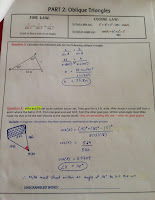
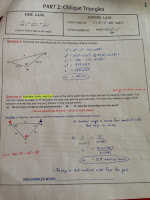
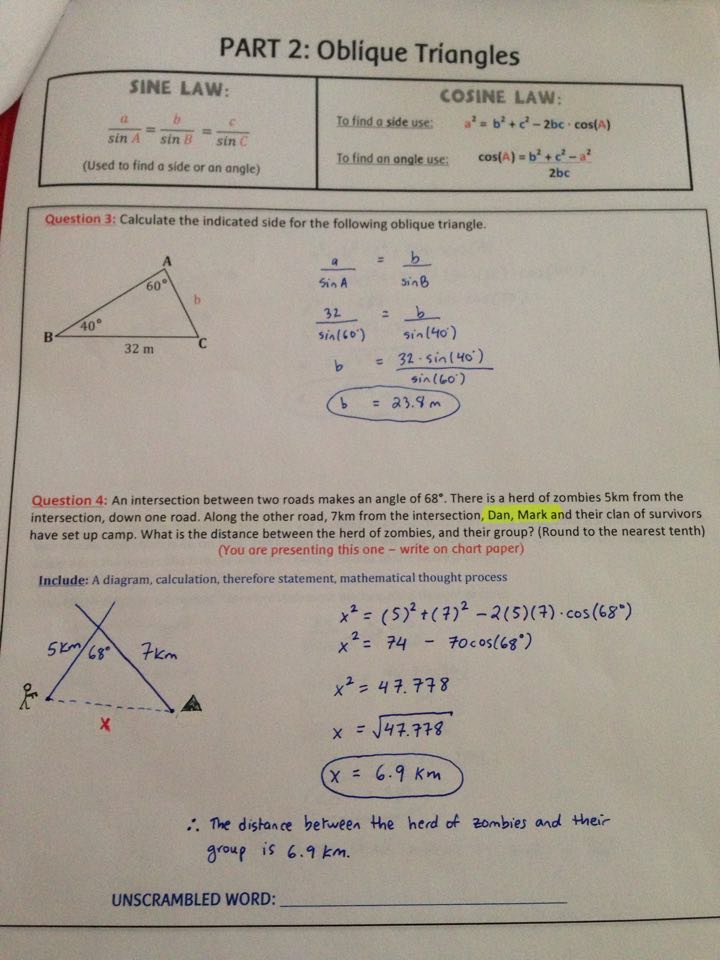
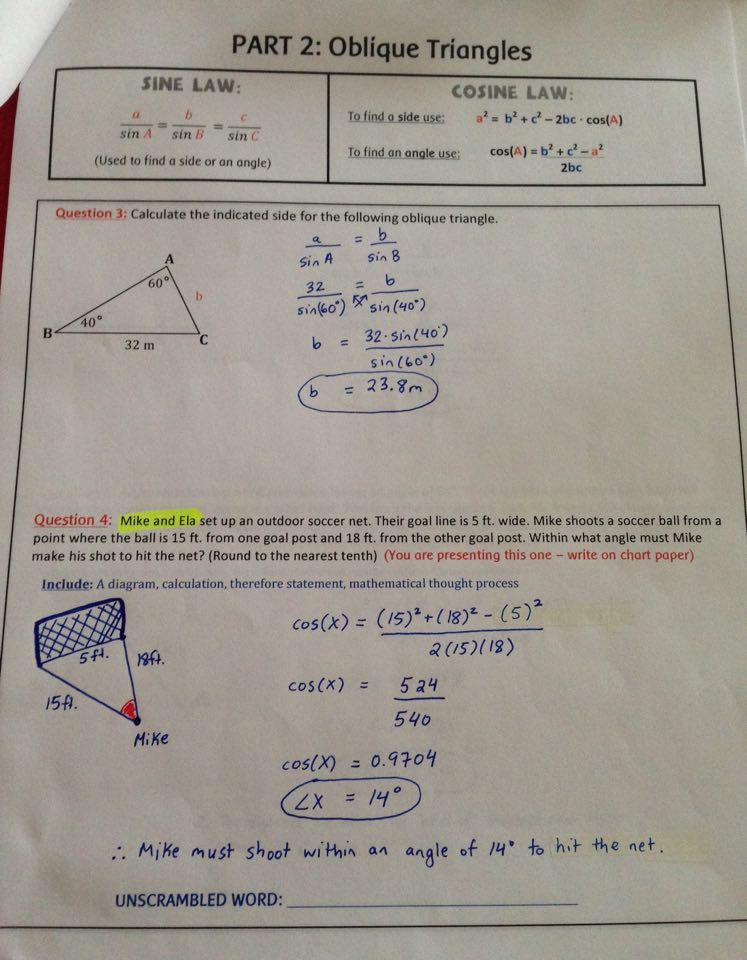
In class this week, I lead a learning activity for a grade 11 University level mathematics class, for a unit in Trigonometry that involved Trigonometric ratios, and the Sine and Cosine Laws. The students were arranged into groups of 2-3 since we have a smaller class size, however with a regular class size, it would be best to have larger groups of 3-4 students. The instructions of the activity were explained to the class verbally, and the written instructions were displayed on the board to accommodate all students. In this activity, the students were given a worksheet and were asked to work together to solve the 4 questions provided. This activity also involved a word scramble, where the students were able to unlock some of the letters to the mystery word after answering each question on their worksheet correctly. In addition, each group was given a HELP card, where they had the option to call on another member from a different group for assistance if they were struggling with a question. The HELP card could only be used once, and it was added into the activity to limit teacher intervention and encourage the students to work together. The last question on the worksheet was a word problem that was to be written on chart paper and presented to the class. Each group received a different word problem on their handout, and their presentation needed to include a diagram, calculations, and their mathematical thought process. In a real class setting, after completing the activity, the students can be given the opportunity to walk around to view each groups work on the word problems, copy them down into their notes, and make sure they have a good understand of how to solve each problem.


First page of the worksheet
Some of the key points in this activity are that it is important to strategically place students into groups, ensuring that each group consists of students with a range of abilities. This will create a positive learning environment, and encourage peer tutoring and collaboration. This activity caters to both instrumental and relational understanding and it is best utilized as a review, after the students have learned these concepts in class. Thus, the teacher should refrain from quickly assisting the students, and wait until they have used their HELP card (assistance from another group) before stepping in to assist struggling students. The teacher should also be circulating the room to ensure the students are on track, working together, and that everyone is participating in the activity. Additionally, it would be beneficial for the teacher to keep anecdotal records or to use a checklist to track student progress. Another important note is that the teacher should ensure that the students have enough time to work through the worksheet before presenting their problem to the class. Lastly, the word scramble portion of the activity promotes literacy, and it was a great way to get the students interested and keep them on track, since they wanted to keep unlocking letters to solve the final puzzle.

This activity can also be structured as a competition, however the teacher should make that decision based on the students maturity level. It is important to ensure that the students aren’t rushing to win, and that they are all participating and learning through the activity. Another option would be to give each group a prize after everyone has answered all four activity questions and completed the word scramble. In this way, everyone will be able to enjoy a reward!
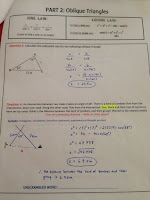
                                           
                                     Above is the second page of the worksheet for each group


Saturday, 23 January 2016

Group Learning through Activities in the Classroom (Week 10 Reflection)

In class this week, we participated in a learning activity for a grade 10 applied mathematics class, involving linear systems. The technological tool, Visual Basic, was used to demonstrate graphing the linear equation y = mx + b and the changes in the slope and y-intercept were explored. After the review of linear equations, we were divided into groups in a way that would be very fun and engaging for students. Each student randomly selected a paper with a letter on it, and was asked to call out a food that starts with the letter they were given. The groups were then created by grouping the students who called out foods starting with the same letter. A simple exercise like this is a great opportunity to get the students interested and excited before participating in the activity.

In the group activity, each student was assigned a word problem that involved the process of first figuring out the linear system, and then using either substitution or elimination to solve for the unknown variables. This was a great activity because each group member had to work together and write their final answer on a chart paper, that was later presented to the class. Collaborative learning is very beneficial for all students because they learn how to work with others, obtain knowledge from their peers, and they are able to help those who are having difficulty. Group work often allows students to feel more comfortable and less anxious when working on a problem they do not fully understand, which creates an effective and positive classroom environment.  
A solution to a group's assigned word problem

After completing the activity and sharing the results with our peers, it was interesting to discover that everyone used the substitution method to solve for the unknown variables, opposed to elimination method. This was particularly interesting because the linear systems were simple enough that using elimination would have been easier and more efficient. Through discussion with the class, we came to the conclusion that we all chose to use substitution because we all felt more comfortable with it, since we were taught that method first as young students, and it was the most practiced method. It would be interesting to discover if we all would have used elimination if we were taught that method first in school.
Another solution a group's assigned word problem
Another activity that we did in class involved conceptualizing and representing linear relationships. In pairs, we had to analyze the given dot pattern and find the general formula to predict the number of dots at any given minute of the sequence. The purpose of this activity was to see how people visualize the sequence of dots differently, and it was interesting to hear everyone’s thought process once we presented our ideas on a chart paper. In pairs, we came up with various ideas to explain the sequence. Some students visualized the sequence in stages, while others imagined the sequence changing all in one step. Some examples used to describe the sequence were Bacteria growth, Cell division, and 1 petal being added to each stem like a growing flower. It is very important to encourage students to conceptualize math problems in different ways because it allows students to think more abstractly, and view questions from different perspectives.

The photos above are from the conceptualizing and representing dots problem

Sunday, 17 January 2016

Positive Attitude and Approach toward teaching Secondary Mathematics (Week 9 Reflection)

The article Adolescent Learning and Secondary Mathematics stressed that an important part of teaching is creating a positive and engaging classroom environment for students. According to the article, this can be done by introducing more group work, giving attention to students’ ideas and interests, and using their social world to produce more engaged learners. I agree with these ideas as a means to increase engagement because I had success using similar techniques in the grade 11 Math class I was teaching during my first practicum.  I found it very beneficial to get to know the students, and incorporate their personal interests into the lessons I was teaching, as well as their homework questions. Simply integrating the students’ names into the word problems and creating math questions around their favourite sport or TV show really captured their interest in learning mathematics. Not only did I notice an improvement in their engagement and participation in my class, but in addition the students appeared to be in a good mood, resulting in a positive classroom environment. It was amazing to see what a positive impact showing the students you care has on their whole attitude toward learning.

Another key point that the article addresses is cognitive bullying, which describes the kind of teaching that ignores or negates the way a student thinks, imposes unnatural thought processes, undermines the students’ effort, and causes stress. These actions are reoccurring over time. Ultimately, cognitive bullying contributes to generating fear and anxiety over certain mathematical concepts due to the students’ negative experiences in the classroom, and this negatively impacts their learning. As a student, I was fortunate enough to have teachers who were very open to using a variety of methods to solve mathematical problems, and they did not force students to only approach a problem the way it was being taught. I recall using different methods than my teachers on a number of occasions and asking them if my methods were acceptable. After checking my work, my teachers approved the techniques I used and provided positive feedback and encouragement for trying something new, as oppose to disregarding my work and telling me to do it “their way”. As a result of these positive experiences, I was able to grow as a learner and I was inspired to explore many methods of solving different math problems.


 As a teacher, it is very important to get to know your students and structure your lessons around their learning needs. Students in your classroom will not all learn the same way; therefore differentiated instruction is very important. Teachers must have patients and work on building students self-esteem when teaching mathematics, especially with the weaker students. Sometimes knowing that someone believes in you, and wants you to succeed is all the motivation needed in order for a student to be in the right mind frame and willing to learn math. According to the article, an effective way to build the students confidence is by starting a task with something they know fairly well, and continuously building off of that to teach a new concept. This approach recognizes learners’ existing knowledge, and offers the opportunity to add more information to their preexisting knowledge base. By building up the learners’ self-esteem first, it is more likely that they will be open to learning the new material and feel empowered to succeed.

Saturday, 24 October 2015

Different Styles of Teaching (Week 6 Reflection)

The article "Teaching is a Cultural Activity" discusses the different cultural scripts of teachers and their effect on student’s learning. Teachers and students in a school share the same script in their mind around teaching. They know what is expected and what role to play through implicit observation and participation. Furthermore, students seem to be accustomed to similar routines, teaching styles, and day-to-day classroom activities which makes it difficult for students to adjust and perform well when their teacher suddenly implements significant changes to their instructional methods. According to the article, a U.S. fourth grade teacher watched a video of a Japanese lesson and followed that same style of teaching in his next class. Unfortunately, the U.S. teacher’s students failed to respond like the ones in the video. As teachers we should not be repetitive and predictable. Using differentiated instructional strategies early on in the year and consistently will benefit the students and allow them to experience learning using alternate methods. By involving new activities and using different formats to the lesson, students will grow and expand their learning capabilities, resulting in higher order thinking.  


Japanese Classroom
There are different beliefs on how students learn across cultures. U.S. and Japanese teachers have very different views and teaching styles in their classroom. U.S. teachers want their students to learn skills, procedures and follow a systematic approach, whereas Japanese teachers want their students to think about things in a new way and see relationships between mathematical ideas through self-discovery. These goals create a very different classroom environment. U.S. teachers show steps and examples of how to solve a problem by starting with an easy example and then moving on to the difficult ones. They constantly try to keep students focused and attentive during the lesson, otherwise they will get lost if they miss a step. Japanese teachers believe students learn best by first struggling to solve the problem, discussing it with their peers, and understanding many different methods to solve the problem, not just one. They do not need to focus on keeping the student’s attention because they feel the students are already interested in the subject, and they use a chalkboard to have a cumulative record of their class.

U.S. Classroom
Japanese teachers and U.S teachers use completely opposite methods of teaching. I find it interesting how U.S. teachers try to avoid creating confusion, and feel as if they are not doing their job correctly if the students are confused. Whereas Japanese teachers start their lesson by giving the students a challenging question, and have them struggle to solve the problem. I believe it is important to challenge students and allow them to engage in deep thinking because it will expand their problem solving capabilities, thinking capacity, and improve their intelligence. We should allow students to figure out problems on their own instead of always showing them the method and steps to solve every problem they are given.

Throughout my time as a High School student, I have mostly experienced the U.S. methods of teaching where procedures and steps were given through examples and I was required to follow these methods. I enjoyed this method of learning at the time, however when I encountered math problems in University it was a little more difficult to transition since straightforward steps on how to solve each problem were no longer given. As a result of this experience, I will definitely use a combination of both the U.S. and Japanese styles of teaching in my classroom because it will allow students to grow as critical thinkers and prepare them for future success. Students need to learn at an early age how to be critical thinkers and investigate problems without a step-by-step process available to them so that when they get to University they will already be accustomed to the teaching methods they will encounter.

Thursday, 15 October 2015

Splurge Diagrams and their use in Mathematics (Week 5 Reflection)

A Splurge diagram is a very useful tool that teachers and students can use to help organize thoughts and ideas about a particular topic. By writing down all of the things that come to mind about a topic, Splurge diagrams inspire new ideas, and help make connections to other topics or concepts. Splurge Diagrams can be very beneficial to teachers because the more these diagrams are drawn, the more teachers can draw connections to other parts of the curriculum and ultimately realize how the curriculum can become more connected. Furthermore, Splurge diagrams can help make it clear what prior knowledge students need before teaching a new lesson, and they can help expand ideas on different teaching strategies.  The book "Adapting and Extending Secondary Mathematics Activities: New Tasks for Old" discusses how the use of Splurge diagrams can have a positive impact on teaching methods and classroom dynamic by offering teachers a structure for considering many other elements that will affect how tasks are designed. Teachers can organize their curriculum expectations, big ideas, learning goals, teaching methods, and a variety of resources through the use of these concept maps, and they can share ideas with their colleagues by collaborating and drawing them together.
              
Students can use Splurge diagrams to their advantage while writing papers. Teachers can teach their students to use these web diagrams to brainstorm and organize their thoughts before diving right into a paper. As a student, I have often used Splurge diagrams before writing an essay to organize my thoughts for the introduction, thesis, body paragraphs, and conclusion. I find it is a great tool to stimulate ideas and to eliminate the struggle of writer’s block. In the book "Adapting and Extending Secondary Mathematics Activities: New Tasks for Old" it is clear that when examining Figure 2.4 A Splurge diagram for Solving Equations, how visible the complexity becomes as the Splurge diagram develops. Although some topics at first may seem rather simple, as you begin to create your splurge diagram and your thoughts start flowing, it can become a very complex structure full of ideas.
                              
Splurge diagrams can also be used in mathematics. The Polya’s Problem Solving process involves Understanding the Problem, Devising a Plan, Carrying out the Plan, and Looking Back. Students can use a splurge diagram to help them understand the problem and devise a Problem Solving plan. Students can organize what information the question provides, brainstorming ways to approach the question, and think of different methods that can be used to solve the problem in their web diagram. This will give students a goal and set them on the right track to solving the problem. Teachers cannot only rely on tools to motivate their students to learn, they must encourage their students and inspire positive attitudes around learning mathematics. A proactive student will be confident to try many strategies, risk making mistakes, have a willingness to persevere when solutions are not immediate, and have the ability to accept frustration that comes from not knowing. Teacher’s need to understand the importance of a positive classroom environment to ensure students are able to develop positive attitudes and feel safe to try or ask anything within your classroom.
        

Sunday, 4 October 2015

Enhancing the approach for Teaching Mathematics (Week 4 Reflection)

As a prospective teacher, I have learned various high-level mathematical concepts throughout the many math courses required in my program. However, I have gained little knowledge on how to teach mathematics to students effectively, since very few of these courses were relevant to the grade level I will be teaching.  The article 'Toward a Practice-Base Theory of Mathematical Knowledge for Teaching' argues the notion that learning more advanced mathematics does not necessarily contribute to a prospective teacher’s effectiveness with young students. Therefore, knowing and understanding high-level math does not benefit a teacher’s quality of teaching mathematics. A problem is that prospective teachers do not review or thoroughly study the material that they will actually be teaching in the classroom. Thus, they are not becoming experts on how to teach this material in the most effective way to engage a variety of learners.

 I often hear prospective teachers say that they are worried to teach in their second teachable during their upcoming teaching block because they “haven’t seen some of that material since High School”. It is shocking that even though we have taken many courses related to the subject we will be teaching, we still do not feel prepared or comfortable enough to begin teaching it to students. It seems that inadequate opportunities exist for teachers to learn mathematics in ways that prepare them for work.

            I feel that in order to fix this problem, the concurrent education program should dedicate part of it’s program to courses that review the High School mathematics program and teach us various teaching strategies on how to best teach that material in a variety of ways. We should become experts in the material we will be teaching and be prepared on how to answer any question a student poses during our lessons. Based on the reading 'Toward a Practice-Base Theory of Mathematical Knowledge for Teachinga teacher successfully showed students how to multiply and divide, however when a child asked for an explanation on why the invert-and-multiply algorithm for dividing fractions works, the teacher could not provide an answer and told the student to just use it as a rule for now.  It is critical that prospective teachers have a strong understanding of the fundamentals of mathematical principles, so that they can properly educate their students on mathematical concepts. Having more mathematical knowledge is useless unless you have the ability to facilitate students learning. It would be most beneficial for prospective teachers to have plenty of practice teaching content to their peers before getting thrown into their teaching blocks. 


            As a student I have not had the opportunity to experience many teachers who were able to properly explain why we use the rules and methods that were being applied. This was very difficult as a learner because I was just memorizing how to do the math instead of realizing when and why certain rules should be used. The teachers that were able to provide explanations had the most positive effect on my learning because remembering the reason why you use a rule has a more lasting impact then simply memorizing when to use it. The understanding of how mathematical principles were derived ensured that I had a deeper and more complete understanding of the material.